
 By
By 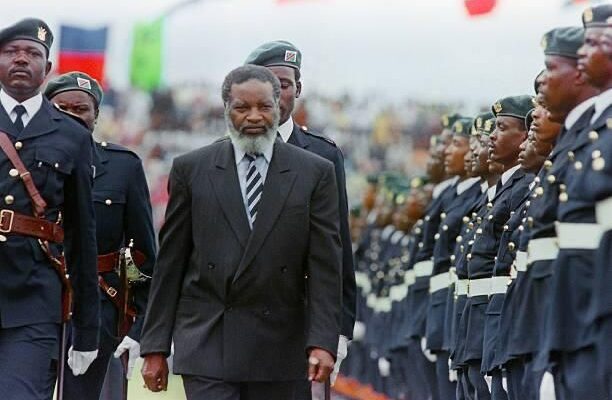
Namibia’s Founding President Sam Nujoma Dies at 95
Windhoek, Namibia – Namibia is mourning the passing of Samuel Shafiishuna Daniel Nujoma, the country’s Founding President and liberation icon, who has died at the age of 95. The revered leader, who played a pivotal role in Namibia’s independence struggle, passed away on February 6, 2025.
Nujoma was the first President of Namibia, serving from 1990 to 2005, and is widely recognized for leading the country’s decades-long struggle against South African apartheid rule. His death marks the end of an era for Namibia and Africa, as he was one of the last surviving liberation leaders who fought for independence across the continent.
A Life Dedicated to Freedom
Born on May 12, 1929, in Ongandjera in northern Namibia, Sam Nujoma’s journey into politics began in the 1950s when he joined the Ovambo People’s Organization (OPO), a movement advocating for the rights of Namibians under South African rule. In 1959, he played a central role in mobilizing resistance against apartheid policies, particularly during the Old Location Uprising in Windhoek, where South African forces opened fire on protesters opposing forced removals.
Following the massacre, Nujoma went into exile on March 1, 1960, embarking on a perilous journey through Botswana, Zimbabwe, Zambia, and Tanzania, before reaching Ghana and later the United States, where he petitioned the United Nations General Assembly for Namibia’s independence. Shortly after, on April 19, 1960, he became the founding President of the South West Africa People’s Organization (SWAPO), the movement that would lead Namibia’s liberation.
Leader of the Armed Struggle
Under Nujoma’s leadership, SWAPO’s military wing, the People’s Liberation Army of Namibia (PLAN), launched an armed struggle against South Africa’s Defence Forces in 1966. The war for independence lasted over two decades, with SWAPO fighters waging a guerrilla campaign from exile, primarily operating from Angola and Zambia.
The conflict ended in 1989, following a United Nations-brokered peace agreement that led to Namibia’s first democratic elections. SWAPO emerged victorious, and on March 21, 1990, Namibia officially gained independence, with Sam Nujoma sworn in as the nation’s first President.
Presidency and Nation-Building
Nujoma led Namibia for 15 years, serving three terms as President from 1990 to 2005. His tenure focused on national reconciliation, economic development, and consolidating Namibia’s sovereignty after decades of colonial rule. His leadership was crucial in shaping the country’s policies on land reform, education, and health care.
While he was occasionally criticized for centralizing power within SWAPO, his commitment to Namibia’s progress and stability remains widely acknowledged. After stepping down in 2005, he continued to serve as a mentor and elder statesman, guiding future generations of Namibian leaders.
A Legacy that Endures
Sam Nujoma’s contributions to Namibia and Africa extend beyond politics. His resilience, strategic leadership, and vision for an independent Namibia solidified his place in history alongside other African liberation icons like Nelson Mandela, Julius Nyerere, and Robert Mugabe.
His passage through Botswana’s Francistown in 1960 remains one of the most daring moments in Southern Africa’s liberation struggle, highlighting the solidarity among African nations in the fight against colonial rule.
As Namibia and the world bid farewell to one of Africa’s greatest revolutionaries, tributes are pouring in from across the continent. Leaders from across Africa, including the African Union, SADC, and former allies in Angola, Cuba, and Russia, have expressed their condolences.
Flags across Namibia have been lowered to half-mast as the nation mourns the Father of the Namibian Nation. Funeral arrangements are yet to be announced, but a state funeral is expected to be held in his honor.
Sam Nujoma’s legacy as a liberation hero, visionary leader, and architect of Namibia’s independence will endure for generations to come.
Rest in Power, MHSRIP, Sam Nujoma (1929–2025).